Dictated to Arcturus
Two amusements for chemists
We are now at the stage where we can read the full text of a chemical experiment and extract much of the meaning out of it using natural language processing and other techniques. Because we can do this in high volume we can use machines to find anything that looks slightly unusual. Here are two examples of material that we have found which I’d like readers of this blog to look at and see if they can spot anything unusual. There probably isn’t anything actually wrong with the experiments but there may well be essential details that have not been reported. And
From a patent (a hamburger PDF but you should still be able to read this). Patents are Open so I can’t be sued for reproducing this.

Does anything strike you as slightly strange in this? You do not have to know what naphthyridine is and I think a bright high school student could spot it. (I don’t know the answer to the problem but I can make a good guess).
From: Acta Cryst. (2010). E66, o1029 [ doi:10.1107/S1600536810011888 ] (Open Access!! So I can copy the structure without being pursued by lawyers!)
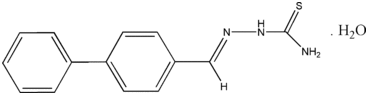
1-(Biphenyl-4-ylmethylidene)thiosemicarbazide monohydrate
Experimental
A solution of 4-biphenylcarboxaldehyde (1.822 g, 0.01 mol) and thiosemicarbazide (0.91 g, 0.01 mol) in absolute methanol (50 ml) was refluxing for 4 h, in the presence of p-toluenesulfonic acid (0.005 g) as catalyst, with continuous stirring. Completeness of the reaction was TLC controlled indicating the disappearance of the aldehyde spot. On cooling to room temperature the precipitate was filtered off, washed with copious cold methanol and dried in air (yield: 1.581 g, 61%; m.p. 475 K). Yellow single crystals compound were obtained after recrystallization from a solution of chloroform/methanol (3:7 v/v) after 10 days at room temperature.
Again there is something slightly odd in this. You don’t have to know what the molecules are to spot the problem, but knowing them might help to answer it (although I don’t actually know the answer). Again a bright high school student might be able to spot the problem.
Please make suggestions and guesses or the robots will be disappointed. I’ll leave three days before answering.
1) Going to be difficult to get a mixture of MeOH and water to 100 degrees. Though I’m not sure what that would actually boil at.
2) It’s not possible to have a reaction that’s “TLC controlled” and there are some other typos, and chloroform/methanol is not a “solution” However it looks like they’ve calculated the yield based on the molecule without the water in the structure, whereas they say it’s a monohydrate.
If you’re automatically flagging errors like this then that’s awesome.
Well spotted for (1). I checked the BPt of mixtures and this is about 1:1 molar which is somwhere about 75. My guess is that they put it in a sealed tube and didn’t mention that.
Well spotted also for the yield in (2) but there is also something slightly missing. I agree the language is imprecise and we are also picking up typos.
Automatons FTW!
Not only is this useful for finding errors after publication,
but actually before any publication. If natural language processing
will be so powerful we don’t need no reviewers anymore.
But maybe angry scientific luddites will rip the RAM out
of the review computer. 🙂
(1)
Anyway the guy, obviously had an 8 hour workday, he came
to work, prepared the experiment for one hour, then needed
to go home and turned the experiment off after 7 hours.
Seems good to me.
(2)
The other person obviously did the experiment on Saturday,
went to vacation for one week, came back on Monday (10 days)
and took the stuff from the window sill and it was rainy
and hot (mixed weather) so writing “room tmperature” and
after 10 days was correct. Seems good to me too.
Well, I also like phrases “a proper amount was added” and
“zinc shots approximately 5-30 grams” where stored under moonlight….
I guess a lot of Bad Science (B.S.) can be cut out if used properly
before publishing a scientific text (including an automated plagiarism check).
Cheers
Tobias